Professions and Work Hours
How your professions and gathering skills grow, what Work Hours are and how they come back, how the crafting and gathering rolls decide what you make, and the XP crafting gives.
For playersSome sims give crafting more depth. You practise a profession and your skill in it grows. Crafting, gathering and repairs cost Work Hours from a pool that refills over time. A roll of the dice decides how well each item comes out. Your sim switches each of these on separately, so parts of this guide may not apply to you. Each section says what it needs.
For the basics of using a station and touching a node, start with Crafting and gathering.
Your professions
A profession is a craft, such as weaponsmith, alchemist or cook. Each one has a skill, usually from 0 to 100. Your sim can also have gathering skills, such as mining or herbalism, for working nodes.
You pick a profession when you make your character, on the Gear step of the character creator. Staff can also give you one. If your sim uses the gathering roll, a gathering skill is added the first time you gather successfully with it.
To see them, press Settings, then Professions. The button is there if your sim uses profession rules.
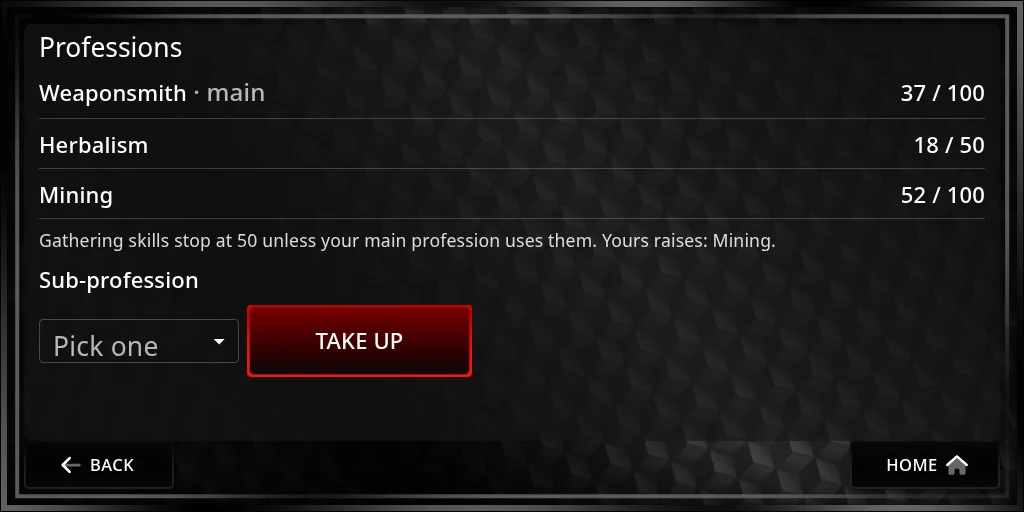
Each line shows your skill over the most you can reach. Your main profession and your sub-profession are marked. The page doesn’t show the XP towards your next point. That shows after each craft, see How skill grows.
Main and sub-profession
- Main profession: the one you picked when you made your character, or the first crafting profession you learned. It can go all the way, usually to 100.
- Sub-profession: from a character level your sim sets (10 by default), you can take up one more crafting profession. It starts at skill 1 and stops at 50. You only get one.
- Any other crafting profession, such as one staff gave you, also stops at 50.
To take up a sub-profession:
- On the Professions page, open Pick one under Sub-profession and choose one.
- Press Take up.
- The page asks, for example, “Take up Bowyer as your sub-profession? It stops at skill 50, and you only get one.” Press Yes, take it up, or Back.
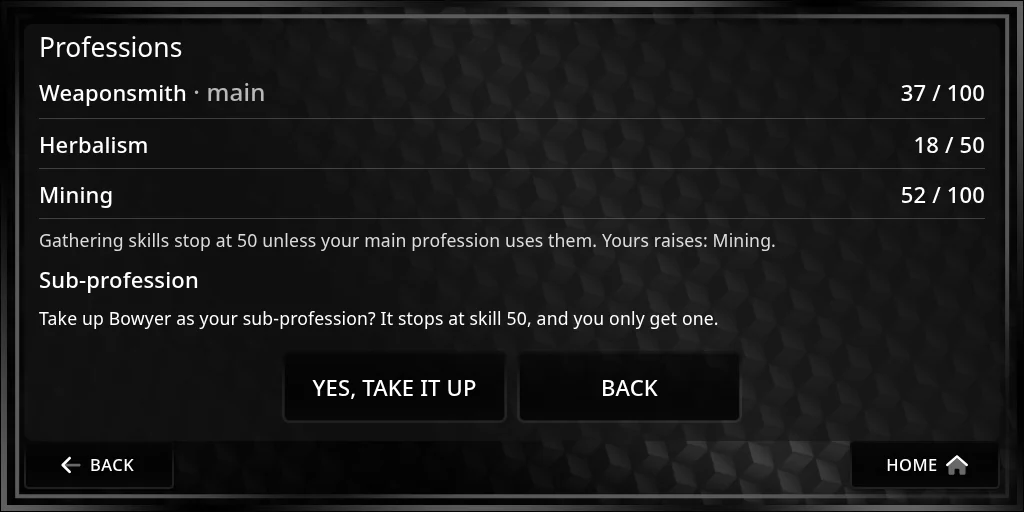
If you can’t pick one yet, the page says why after Not now:, such as “from level 10” or “you have one: Bowyer”.
Gathering skills
Gathering skills stop at 50, unless your main profession uses that skill. The page says which ones yours raises, for example “Yours raises: Mining.” A weaponsmith can take mining past 50, but an alchemist can’t.
Change your main profession
A letter of indenture binds you to a new trade. It names a crafting profession.
- Open Inventory and pick the letter.
- Press Use letter.
- The HUD says what will happen: which profession you’ll become, at what skill, and which one you’ll give up. Press USE LETTER to go ahead, or CANCEL.
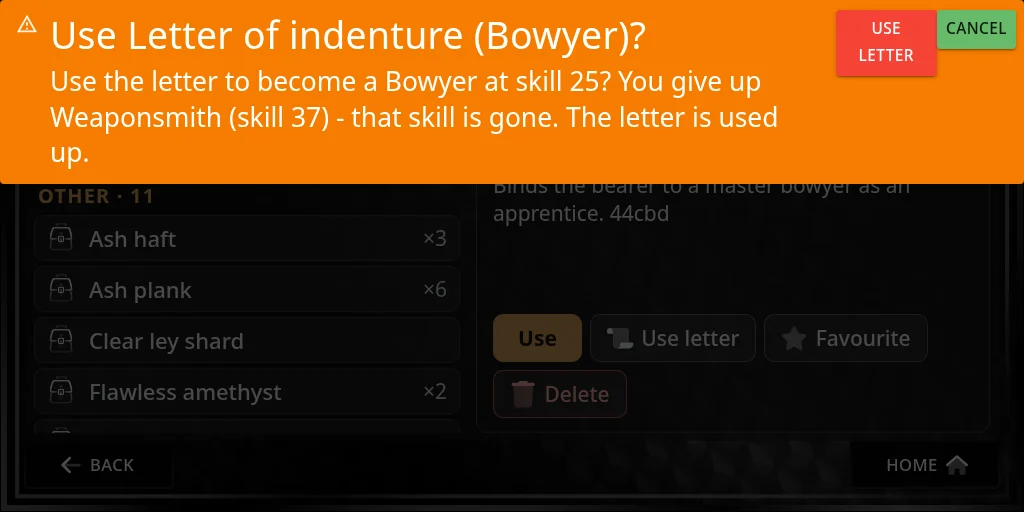
- You start the new profession at skill 25. If you already had more skill in it, you keep that.
- Your old main profession is gone, skill and all.
- If the new one was your sub-profession, you can pick a new sub-profession.
- The letter is used up. You can’t use one during a fight.
How skill grows
If your sim uses profession skill gain, a successful craft gives XP in the profession the recipe needs. Your XP buys skill points, one at a time.
How much XP a craft gives
Your skill puts you in a tier, and so does every recipe. A recipe’s tier is set by the profession level it needs.
| Skill | Tier |
|---|---|
| 0 to 24 | 1 |
| 25 to 49 | 2 |
| 50 to 74 | 3 |
| 75 to 99 | 4 |
| 100 | 5 |
For each item you make, you get XP for every Work Hour it took, including care (see Work Hours):
- A recipe at your tier or above: 3 XP a Work Hour.
- A recipe one tier below you: 1 XP a Work Hour, a third as much.
- A recipe two or more tiers below you: nothing. Easy work stops teaching you.
For example, a weaponsmith at skill 37 is tier 2. A tier 2 recipe that takes 2 Work Hours gives 6 XP. With 2 hours of care it takes 4 Work Hours and gives 12 XP.
Your sim can set a recipe’s profession XP itself, and some recipes take no Work Hours at all. Simple refining, such as smelting ore into ingots, takes no time and teaches nothing.
Only a craft that works counts. A Crude item still counts. A Ruined attempt, or one that fails, gives no XP.
What a skill point costs
| Skill | Rank | XP for each point |
|---|---|---|
| 0 to 24 | Apprentice | 6 |
| 25 to 49 | Journeyman | 18 |
| 50 to 74 | Artisan | 54 |
| 75 and up | Master | 90 |
These are the usual numbers. Your sim can set its own for each profession. XP left over carries on to the next point. Once you’re at the most you can reach, extra XP is lost.
Going from skill 1 to 100 takes about 4,200 XP. At 3 XP a Work Hour, that’s about 1,400 Work Hours of work at your own tier.
See your progress
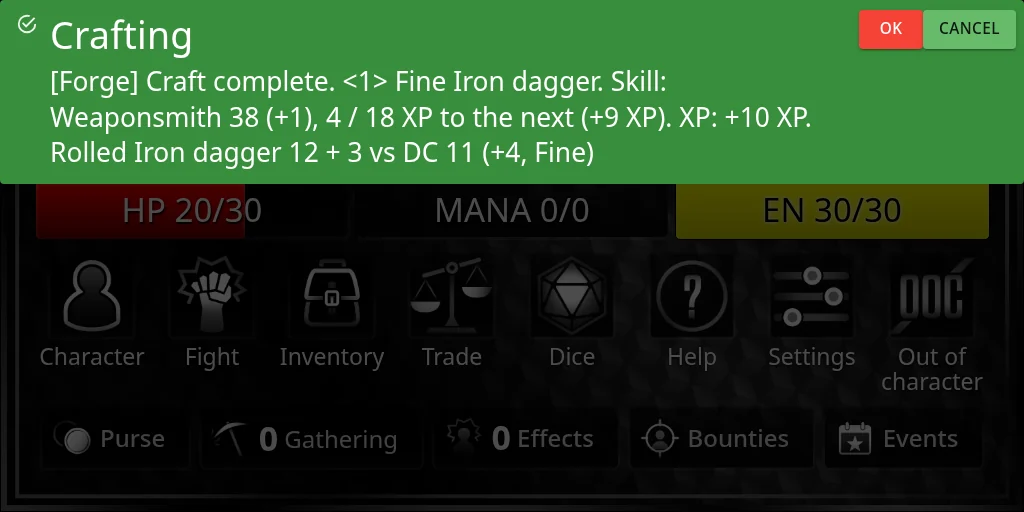
When a craft finishes, the HUD shows what you made, then your skill. For example: “Skill: Weaponsmith 38 (+1), 4 / 18 XP to the next (+9 XP)”. That means you went up a point to 38, you have 4 of the 18 XP for the next one, and the craft gave you 9 XP. At your limit, the line ends “(the most you can reach as a sub-profession)” or “without a main profession that uses it”.
Your sim’s website also shows each profession’s skill on your character’s page, under Stats & skills.
Work Hours
If your sim uses Work Hours, your account has a pool of them, shared by all your characters. Crafting, gathering and repairs spend them, and they come back over time.
- How many: usually up to 24. A new account starts full.
- Coming back: usually one every 3 hours, while you’re below your cap. Nothing comes back while you’re full, so spend them.
- Your sim sets both numbers, and some sims use far fewer, such as 8.
What spends them
| What | Work Hours, usually |
|---|---|
| Crafting, for each item | 1 at tier 1, 2 at tier 2, 3 at tier 3, 4 at tier 4, 6 at tier 5, plus 1 for each hour of care |
| Gathering, each try | 1, whether you find anything or not |
| Repairing gear yourself | 1 for each tier of the item |
| Care when enchanting | 1 for each hour |
| A Signature contribution | what crafting it at its tier would take |
Some recipes set their own Work Hours. Simple refining usually takes none.
Work Hours are taken before anything else happens. If you don’t have enough, nothing is spent and you’re told what it takes, for example “This craft takes 6 Work Hours; you have 4/24 Work Hours, the next in 1 h 12 min.” With Work Hours, gathering costs Work Hours instead of your daily gathering attempts.
On most sims with Work Hours, a craft also takes an hour of real time for each Work Hour. Some sims use each recipe’s own time instead.
See how many you have
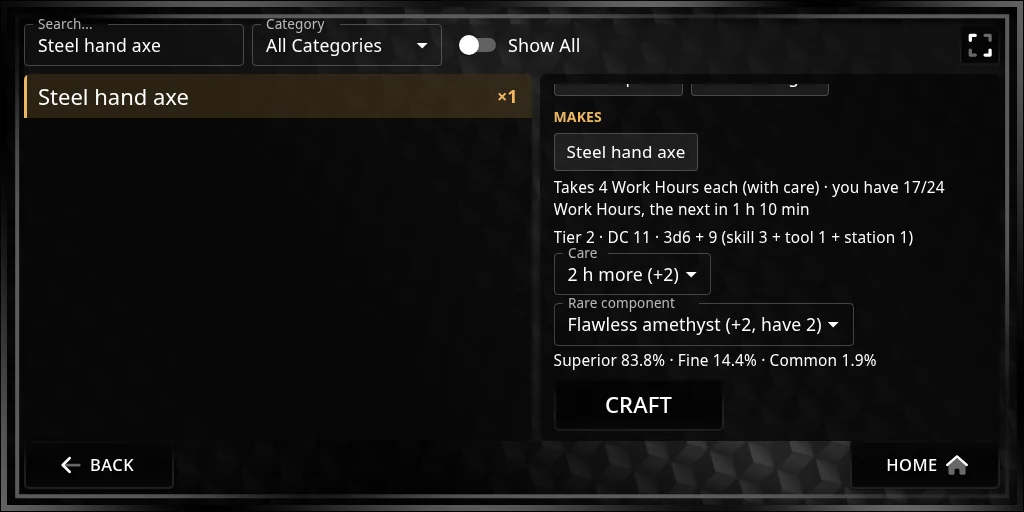
- On a recipe: each recipe says what it takes and what you have, for example “Takes 4 Work Hours each (with care) · you have 17/24 Work Hours, the next in 1 h 10 min”. The screenshot in The crafting roll shows it.
- On the website: press your name at the top right, then My account. The Work Hours card shows how many you have and when the next one comes back.
- In chat: after each craft, gather or repair, for example “6 Work Hours (18 left)”.

Get them back sooner
- A Feast, if your sim has one, gives your account Work Hours back once a day. It never takes you above your cap.
- Some sims’ community projects make Work Hours come back faster for everyone.
- Staff can set your Work Hours by hand.
The crafting roll
If your sim uses the crafting roll, every item you make rolls 3d6 to see how well it comes out. Each recipe shows its tier, the number to beat (the DC) and your bonus, with the odds of each result.
The number to beat
| Recipe tier | DC, usually |
|---|---|
| 1 | 8 |
| 2 | 11 |
| 3 | 14 |
| 4 | 17 |
| 5 | 20 |
Your bonus
- Skill: 1 for every 10 skill points in the recipe’s profession. Without the profession, 0.
- Tool: your best tool for that profession, carried. A Fine tool adds 1, Superior 2, Masterwork 3. A Common, Crude or broken one adds nothing. Tools wear down a little with every item.
- Station: some stations, such as a guild workshop, add 1 or 2.
- Care: each extra hour of care adds 1, up to 3. Each hour also costs a Work Hour more for every item and adds an hour to the craft.
- Rare component: adds 2. One is used up for every item you make.
- Other boosts, if your sim has them: a meal, an enchantment on your gear, or a community project.
The line on the recipe lists your skill, tool and station, for example “(skill 3 + tool 1 + station 1)”. The total after 3d6 + also counts care and a rare component.
What you make
Your roll plus your bonus, minus the DC, gives the result:
| You beat the DC by | Result |
|---|---|
| 9 or more | Masterwork |
| 6 to 8 | Superior |
| 3 to 5 | Fine |
| 0 to 2 | Common |
| -1 to -4 | Crude |
| -5 or worse | Ruined |
Easy recipes can only go so high. A tier 1 recipe makes Fine at best, and a tier 2 recipe Superior at best. From tier 4, a Masterwork also needs a rare component. Without one, a Masterwork roll makes Superior, and the recipe says “Masterwork needs a rare component at this tier.”
The item’s name starts with its quality, such as “Fine Steel hand axe”. Better gear lasts longer and can hold more. See Quality, wear and enchanting.
A Ruined attempt makes nothing and gives no XP. You get back half of one item’s materials, rounded down. The Work Hours and any rare component are gone.
Craft with care or a rare component
- Pick the recipe on the crafting page.
- Under Care, choose how many extra hours, such as “2 h more (+2)”. The list is there if your sim allows care.
- Under Rare component, choose one you carry, if you want one. The list is there when you carry one strong enough for the recipe’s tier.
- Read the odds under the lists. They change as you choose.
- Press Craft.
Chat tells you the craft has started, what it cost and your roll bonus, for example “[Forge] Crafting started — ready in 6 h. 6 Work Hours (18 left). Roll: 3d6 + 4 vs DC 11 (skill 3 + tool 1).”
If something’s missing, such as Work Hours, a profession level or the rare component, the HUD says what. Nothing is used up.
Some odds
| Crafter | Odds |
|---|---|
| New crafter, tier 1 recipe, no tool (+0) | Fine 50%, Common 34%, Crude 16%, Ruined 0.5% |
| Skill 25 with a Fine tool, tier 2 (+3) | Superior 16%, Fine 34%, Common 34%, Crude 16%, Ruined 0.5% |
| The same with 3 hours of care (+6) | Superior 50%, Fine 34%, Common 14%, Crude 2% |
| Skill 75, Masterwork tool, master station, tier 4, with a rare component (+14) | Masterwork 38%, Superior 37%, Fine 21%, Common 5% |
Collect what you made
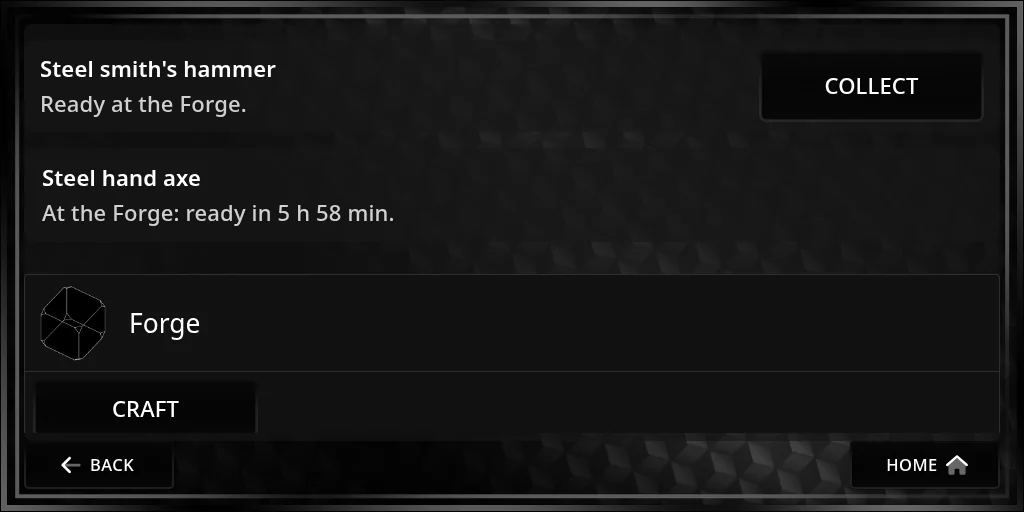
The Crafter page lists your jobs that aren’t done, with the station and the time left. When a job finishes, the HUD shows what you made. A station that keeps your items until you pick them up shows Collect next to the job. Press it, and the items go into your inventory.
The gathering roll
If your sim uses the gathering roll, some nodes need a gathering skill to work:
- A skill level: a stronger node needs more skill, for example “You need Mining 25 to work this (you have 10).”
- A tool: any tool for that skill, even a Common one, for example a pick for mining. A better one adds to the roll. It wears a little with each try, and a broken tool doesn’t count.
You roll 3d6 plus 1 for every 10 skill points, plus your tool, against the node’s DC:
- Success: usually 2 of the node’s main material, plus 1 more for every 4 you beat the DC by, and any extras by their chance.
- Beat it by 6 or more: you can also make a rare find.
- Failure: you still get 1.
Each success gives XP in that gathering skill, usually 3, and with Work Hours each try costs 1 whether you win or not. Chat gives the whole story, for example “Mining: 11 rolled +1 skill +1 Iron pick = 13 against 8 - success by 5. You got 3 Iron ore. Mining 12 (+1), 2 / 6 XP to the next (+3 XP). 1 Work Hour (23 left).”
A node gives a number of harvests, then rests before anyone can work it again. Stronger nodes give fewer harvests and rest longer. Some of the strongest move somewhere else when they’re worked out.
| Node tier | Skill needed | DC | Harvests | Rests for |
|---|---|---|---|---|
| 1 | 0 | 8 | 10 | 1 hour |
| 2 | 25 | 11 | 10 | 2 hours |
| 3 | 50 | 14 | 8 | 4 hours |
| 4 | 75 | 17 | 6 | 8 hours |
| 5 | 100 | 20 | 4 | a day, then it moves |
These are the usual numbers. Your sim sets each node’s own.
If your sim limits nodes, your account also gets a few tries a day at each kind of node (3 by default), shared by all your characters. Every node of the same kind counts together. Chat adds how many you’ve used, for example “(1 of 3 here today)”.
Character XP from crafting
If your sim uses Crafting XP, each item you make also gives your character XP towards their next level, usually 10. Some recipes give more or none, and your sim can cap it each day. The craft’s notice shows it, for example “XP: +10 XP”. See Earning XP.